
ESOP Advisory
Transition ownership on tax-advantaged terms: keep control, reward your team, preserve what you built.
Transition ownership on tax-advantaged terms: keep control, reward your team, preserve what you built.
Leaders in ESOP Advisory
An Ownership Transition that Rewards the People Who Built the Business
Leaders in ESOP Advisory
The Tax-Advantaged Alternative to a Private Equity or Strategic Sale
For many founders, physicians, and owners of closely held businesses, the ideal exit isn’t a sale to a competitor or a private equity fund — where you hand over majority control, answer to a new board, and effectively become an employee of the company you built. An ESOP is a different path: realize liquidity now, keep running the business, and do it more tax-efficiently than any third-party sale.
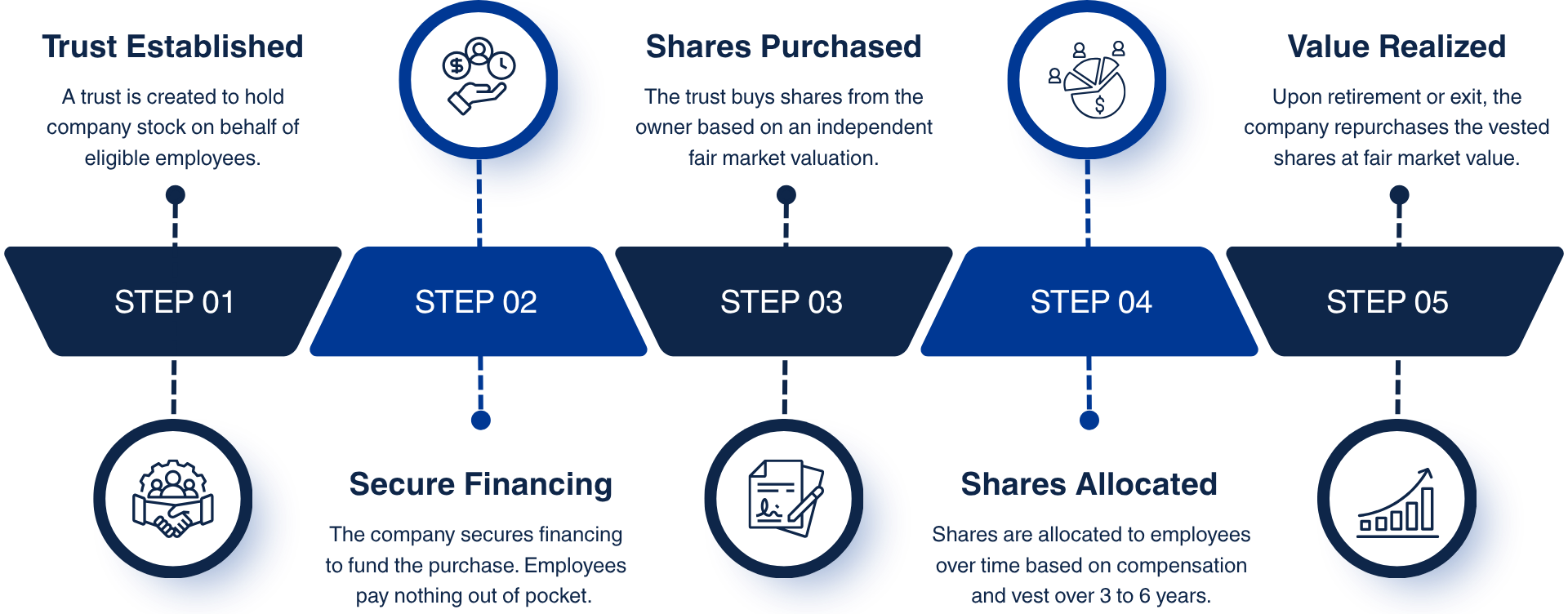
At its core, an Employee Stock Ownership Plan is a qualified retirement plan — authorized under ERISA (1974) — that purchases the stock of the company from the owners. By establishing a trust on behalf of your employees, you sell some or all of your equity to that trust at an independently determined fair-market value, with the company (not your employees) funding the purchase.
As an employee-owned firm ourselves — with more than 30 years of expertise and $15B+ in completed transactions for founder-, family-, and physician-owned businesses — Bloom doesn’t just advise on employee ownership; we live it. We partner with you to evaluate whether an ESOP is the right path for your business and manage the transaction from first analysis to close.

Why Owners Choose an ESOP

Stay in Control
Decide how much to sell — a minority stake or the whole company — and keep running it. Your strategy, your seat, your team, with no majority partner to answer to.

Take Chips Off the Table — and Keep More of Them
Proceeds are taxed as capital gains, not the ordinary rates you pay on distributions today. C-corporation sellers can use a Section 1042 election — partial or full — to defer, and with planning potentially eliminate, that tax. A 100% ESOP-owned S corporation can then operate free of federal income tax.

Keep Your Options Open
Sell a minority stake now and more later, or all of it at once. Employee-owned companies still raise capital, make acquisitions, and can sell to a strategic or PE buyer down the road.

Employee Ownership and Retention
Employees earn a vesting equity stake — a real retention, recruitment, and alignment tool — at no out-of-pocket cost, while the company stays independent.
The Need For A Trusted Advisor
An ESOP is a sophisticated transaction with the advisor being the key architect. Bloom represents the company and its selling shareholders — distinct from the trustee, who represents employees — and manages the process from first analysis to close: feasibility and valuation analysis, transaction structuring/tax planning, capital raising/lender negotiation, and trustee selection. Our firm is with you every step of the way.
Why owners choose Bloom
Is Your Business a Candidate?
ESOPs work seamlessly across C-corporations, S-corporations, and partnerships — and for founders and physician groups alike, they’re a powerful alternative to a private equity or strategic sale, preserving independence and autonomy. To gauge fit, we evaluate your closely held business against three core pillars:
How Does an ESOP Work?
Frequently Asked Questions about ESOPs
Yes. The two most common are leveraged and contributory (non-leveraged) plans. In a leveraged ESOP, the employee trust borrows money to buy an equity stake from the owner — the structure most relevant to a liquidity event. In a contributory plan, the company periodically contributes new shares or cash to the trust.
Yes. An owner can sell a portion of the company to the ESOP, target specific shareholders for a buyout, and sell additional shares to the trust later. Owners can retain non-ESOP equity and continue to run the business.
ERISA (1974) established the modern ESOP and placed it under Department of Labor and IRS oversight. Later bipartisan legislation clarified the rules and expanded the tax incentives available to owners, companies, and employees.
The trust acquires shares on behalf of employees at a price negotiated by an independent trustee, based on an independent valuation. Employees pay nothing; the company secures the financing and repays it on the trust’s behalf.
Eligible employees receive shares generally in proportion to annual W-2 compensation, typically allocated over multiple years and subject to a vesting schedule of roughly three to six years, all defined in the plan document.
When a participant retires or leaves, their vested shares are repurchased at the then-current fair market value. Proceeds can usually be rolled into another qualified retirement plan such as a 401(k) or IRA.
An ESOP keeps the company independent, offers tax advantages a third-party sale doesn’t, and rewards employees. After the transaction, the company is overseen by its board of directors, and selling owners often keep meaningful roles.
Yes. Employee-owned companies routinely make acquisitions, raise capital, complete secondary sales, and pursue future transactions. The structure is durable, not a dead end.
An ESOP-exclusive benefit. A selling shareholder of a C corporation can defer — and, with planning, potentially eliminate — capital gains taxes by reinvesting in Qualified Replacement Property within the period allowed after the sale (generally up to 12 months).
Yes. Contributions used to fund an ESOP are generally tax-deductible within limits, and a 100% ESOP-owned S corporation can become free of federal income tax — cash flow that can accelerate debt repayment and fund growth.
Employees can roll plan proceeds into other tax-deferred retirement accounts. Distributions taken outside a qualified rollover are subject to standard taxes and any early-withdrawal penalties.
Most owners begin with a feasibility study and valuation analysis led by an experienced advisor — quantifying benefits and costs, testing structuring options, and confirming viability before any commitment.
A committee designated by the board selects an independent trustee, usually after interviewing several candidates. After closing, the board of directors continues to oversee management; the trustee maintains a fiduciary oversight role on behalf of employees.
The company and the trustee negotiate, but the trust cannot pay more than fair market value — an independent standard typically built from discounted cash flow analysis, public-company comparisons, and precedent transactions.
Blogs & Insights on ESOPs
In private equity transactions, physicians typically sell a portion of their earnings for upfront cash and equity in an ongoing venture they believe will grow. Another option gaining traction recently is an ESOP which allows the physicians to monetize while retaining control of the practice and providing an amazing benefit to their staff and employees.
In private equity transactions, physicians typically sell a portion of their earnings for upfront cash and equity in an ongoing venture they believe will grow. Another option gaining traction recently is an ESOP which allows the physicians to monetize while retaining control of the practice and providing an amazing benefit to their staff and employees.
The ESOP provides business owners the ability to sell equity ownership to a trust for the benefit of the employees in exchange for cash and stock. ESOP held companies continue to operate in an unmatched tax efficient manner, unlocking new capital for funding growth initiatives and paying down debt more rapidly.
The ESOP provides business owners the ability to sell equity ownership to a trust for the benefit of the employees in exchange for cash and stock. ESOP held companies continue to operate in an unmatched tax efficient manner, unlocking new capital for funding growth initiatives and paying down debt more rapidly.